
Costa Rica Reports Higher Daily Tourism Spending, but a Shorter Average Stay
- Víctor Umaña

- Jul 9
- 5 min read

CET Technical Note 10 examines how visitor spending and length of stay changed between 2006 and 2025.
International visitors to Costa Rica are spending more dollars per day, but staying for fewer nights. This combination marks an important shift in tourism demand and raises questions about competitiveness, value creation, and the country’s ability to sustain longer visits.
Technical Note 10-2026, published by the Center for Tourism Studies (CET), analyzes the evolution of average length of stay and visitor spending between 2006 and 2025. It compares the results of surveys conducted by the Costa Rican Tourism Institute (ICT) with travel receipts recorded in the Central Bank of Costa Rica’s Balance of Payments.
The analysis makes it possible to examine not only how much revenue is recorded per visitor, but also how long tourists stay, how much they spend per day, and how much of the increase measured in US dollars may be linked to changes in prices and the exchange rate.
A Historically Stable Length of Stay That Has Begun to Decline
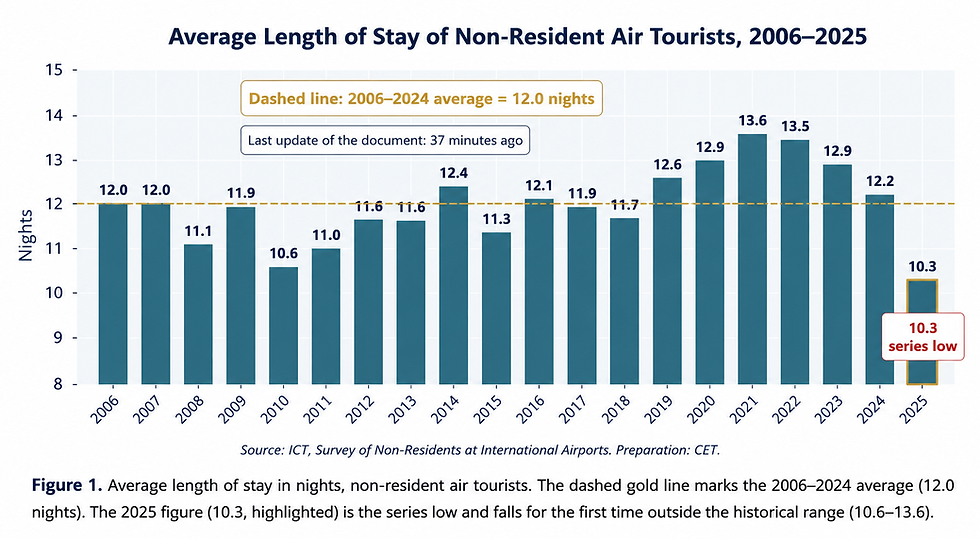
For almost two decades, the average number of nights spent by tourists in Costa Rica remained within a relatively stable range. Even during the pandemic years, those who were able to travel tended to stay longer in the country.
This pattern changed in recent years. Average length of stay began to decline consecutively and reached the lowest level in the series in 2025.
This behavior may be associated with several factors, including changes in visitor segments, a greater share of short trips, shifts in travel itineraries, higher destination costs, or methodological changes in the surveys. The Technical Note does not attribute the result to a single cause, but identifies signals that require continued monitoring and further analysis.

Higher Spending Per Day, but Not Necessarily More Consumption in Real Terms
Average spending per person during the trip increased significantly in US dollars, particularly after 2020. However, this result must be interpreted with caution.
When the duration of the trip declines while total spending remains high, average spending per night increases. This means that visitors are paying more for each day spent in Costa Rica, although they are not necessarily consuming a greater volume of services.
Part of the increase may be explained by higher international prices and by the exchange-rate effect. When the Costa Rican colón appreciates, tourism services priced in colones become more expensive when converted into US dollars. A higher figure in dollars, therefore, does not automatically represent an equivalent increase in consumption or in the real value received by businesses.

The Result Changes When Revenue Is Converted into Colones
To better understand the effect on tourism businesses, the Technical Note converts visitor spending into colones using the average exchange rate for each year.
This comparison shows that the highest figures in US dollars do not always coincide with the highest revenues in local currency. Businesses may bill more dollars per visitor while receiving fewer colones than in previous years.
This is particularly relevant because a large share of operating costs—including wages, social security contributions, utilities, rent, and purchases from domestic suppliers—is paid in colones.
The analysis therefore distinguishes between a nominal increase in US dollars and an effective improvement in the income-generating capacity of tourism activity.

Why Do the ICT and the Central Bank Report Different Figures?
The Technical Note compares two sources that measure tourism spending from different perspectives.
ICT surveys collect information directly from tourists departing through the country’s international airports. Their responses are used to estimate length of stay, declared expenditure, and average spending per person.
The Central Bank, in turn, estimates the foreign currency entering the country under the Travel account of the Balance of Payments. This measure may include flows that visitors do not directly perceive or report, such as some components of tourism packages purchased abroad.
For several years, spending reported by air travelers was higher than the average calculated by the Central Bank. This was expected, because visitors arriving by air generally spend more than those entering through other channels.
However, this relationship changed in some recent years. The Technical Note examines this divergence and highlights the need to consider the exchange-rate effect, methodological changes in the surveys, and differences in coverage between the two sources.

Costa Rica Still Maintains a Long Average Stay Compared with Other Destinations
The decline in average length of stay must also be examined from an international perspective.
Costa Rica has traditionally recorded longer visits than many comparable vacation destinations. This is related to a tourism model in which visitors travel across several regions and combine nature, adventure, beaches, culture, wellness, and protected areas within a single trip.
Even after the decline observed in 2025, the country’s average length of stay remains above that of several destinations in the Caribbean and Latin America.
The main challenge is not only the current level, but the direction of the trend. A sustained reduction could move Costa Rica closer to shorter and more concentrated travel models, limiting the territorial distribution of visitor spending.


What the Statistical Relationships Show
The research includes an exploratory statistical analysis of the relationship between daily spending, the exchange rate, inflation, and selected domestic conditions.
The results suggest that a substantial share of the increase in spending measured in US dollars is associated with the appreciation of the colón and with changes in international prices. In other words, the increase may reflect higher prices more than an equivalent rise in the volume of tourism products and services consumed.
The Technical Note also examines the relationship between security and length of stay. The results show an association between higher homicide rates and shorter visits. CET nevertheless emphasizes that these statistical relationships do not, by themselves, constitute definitive proof of causality.

The Appreciation of the Colón Continued in 2026
The monthly exchange-rate trajectory shows that the appreciation of the colón intensified between the end of 2025 and the first months of 2026.
This movement may once again increase tourism spending measured in US dollars, even when visitors consume a similar volume of services. At the same time, it may reinforce the perception of Costa Rica as an expensive destination and place additional pressure on the margins of businesses that receive dollars while facing rising costs in local currency.

A Transformation That Requires Continued Monitoring
The main conclusion of Technical Note 10 is that Costa Rica’s tourism model is undergoing a change: visitors are spending more dollars per day, but staying for fewer nights.
This result should not be interpreted as entirely positive or negative. Higher daily spending may reflect the country’s ability to attract higher-value visitor segments, but a prolonged decline in length of stay may reduce total expenditure, mobility between regions, and the distribution of benefits among businesses and communities.
Future performance will depend on the destination’s ability to justify higher prices through a strong value proposition, improve mobility and the visitor experience, strengthen security, and preserve the appeal of itineraries that encourage travel across different regions of the country.
The full Technical Note presents the historical series, comparative tables, methodology, statistical estimates, and sources used in the analysis.
Download Technical Note 10-2026: Costa Rica: Average Length of Stay and Visitor Spending. ICT Surveys Compared with the Central Bank’s Balance of Payments.
Author: Víctor Umaña, Executive Director of the Center for Tourism Studies.
Period analyzed: 2006–2025.
Published: July 2026.


Comments